Physical Computing and Fridges

Fridges seem like a good starting point for examples of Physical Computing. It is an object that we interact with each day, which has a number of data points that we currently work out in our heads (what food is in their, how much is there of each product and when does it go off). There have been a number of people and companies looking into this space. The following is a list of developments going on in this area. 


LG Innovation arm Smart Thinq have come up with a Fridge that will help you diet. The new Health Manager will help you build a personal profile, then suggests recipes, daily and weekly meal plans, menus, and food selections based on age, gender, weight, height, and BMI.


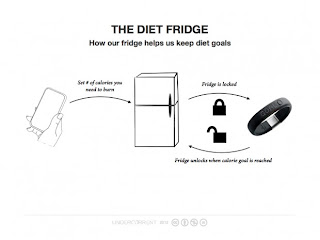
The Digital Strategy Agency Undercurrent have also recently had a look at updating the technology in a fridge. The working prototype had scales inside to measure how much milk is left and alert you when you were running low. They also took on the dieting issue, connecting your fridge to a fitbit to measure how much you exercise and unlocking the fridge when you had reached your quota. Read the full article as it is an interesting read as they have shown how an Agency looks at the creation process of building a physical computing prototype. 

Evian Water have also been getting involved in this area with the Evian Water Magnet. It lets people order Evian water from their fridges, I think this is a massive step from a high profile brand to do this. I am guessing the home delivery system in Europe is different to how it works in Australia and US, as I don't think the infrastructure would be set up to allow this to happen in these countries. 
There was also a similar concept done by Dubai Pizza company 'Red Tomato Pizza'. In this video you can see how the magnet is connected via bluetooth. 


Inside the fridge there has also been examples of Physical Computing Innovation. Crowd Sourced Product Innovation Company Quirky partnered with GE to create the Smart Milk Jug the 'Milkmaid'. It lets you know when your Milk is going off through measuring the PH level and temperature of the milk through sensors in the base. Read more about the technology on TechCrunch


'In MY Fridge' is a student project from the University of Applied Sciences in Schwabisch. They created a fridge with a touch screen on the front that allowed you to see what was inside the fridge and what you could make with the products. This is based on an RFID system which requires you to print off tags that you stick on the products when they go into the fridge.

Tagging items seems like the biggest barrier at the moment in the whole Physical Computing for Fridges space. However I expect that there will be some tech developments most likely around barcodes and using them as a product recognition element which should help to eliminate that issue.

10 Agency Labs making Digital Physical Projects


With the great Twitter/Arduino/Fuelband Mash Up from Stink Digital the other day, I thought I would look at the best Digital Physical projects coming out of Advertising/Media Labs. 

1. Twitter Fuel (StinkDigital)
Tweetfuel from Stinkdigital on Vimeo.


2. LikeBelt (Deeplocal
LikeBelt from deeplocal on Vimeo.


3. Like Light and Beeri (RedPepper
LikeLight from redpepper on Vimeo.


Beeri from redpepper on Vimeo.


4. Love Song Machine (Tellart)
Love Song Machine from Tellart on Vimeo.


5. Frogger (Devito Verdi)
5th Ave Frogger from Tyler DeAngelo on Vimeo.


6. Instaprint (BreakfastNY
Instaprint from BREAKFAST ny on Vimeo.


7. BakerTweet (Poke
BakerTweet from POKE on Vimeo.


8. Christmas Contraption (Ideaworks

9. Little Printer (Berg)


10. Real World Analytics Desktop (Mediacom
More about the project 


Digital Physical, Physical Computing, Ambient Intelligence, Pervasive Computing, Ubiquitous Computing, Internet of things?


Digital Physical is growing in popularity by the day, Aden Hepburn the man behind the leading blog Digital Buzz Blog even gave it a nod yesterday. 

'Lately it has actually been hard to spot an innovative project or campaign that in some way, shape or form, doesn’t use the Arduino board, and while that might seem very single minded, it’s actually a great pat on the back for a more physical-digital world, which is anything but.'

With the lowering cost of entry through the DIY community and Kickstarter being able to fund a number of these digital physical products we are seeing more people enter this space. However unlike the Social Media wave of 2008-10, there is no unifying term for this type of technology.   

I have heard this area being called a number of things from Physical Computing, Pervasive Computing, Digital Physical, Phygital, Ubiquitous Computing and the Internet/Web of Things.

Looking at Google Search Insights it does not look like there is one term that is taking precedence either. If anything I would say that it looks like Digital Physical. 


When you look at the companies who are making these types of products, there is no one solid category terming either. Take the mission statements for the following companies. 

Deeplocal - An innovation studio that creates remarkable experiences for brands 
SuperMechanical - Objects that connect us 
BreakfastNY - A physical-digital interactive agency 
Tellart - Experience Design and Engineering 

I think that it would be advantageous to all everyone involved if there was one unifying term for this technology and I am sure with time there will be. What do you think it should be called?

Eating Data - The Future of Data Visualization

Last week I went to the ITP showcase which had a number of amazing projects. I was surprised by the amount of people using Kinect in their projects. Processing and OpenFrameworks were definitely the programming languages of choice for the projects. Here are four of the projects that I liked;

1. Cupcake Index 


The Cupcake Index takes the results of the World Happiness Rankings and creates cupcakes for every country adding sugar to the cupcake depending on the countries happiness ranking. E.g The sweetest cupcakes are Denmark the happiest country in the world whereas there is no sugar in Central African Republic the least happy country in the world. 


Data visualization is a hot topic at the moment. However I think this project shows that there are more senses at peoples disposal than we are currently using to interact with data. Tasting a data point is a really unique way of getting people to interact with data. How could we hear, smell, touch, or sense data? 

2. BurritoBot 

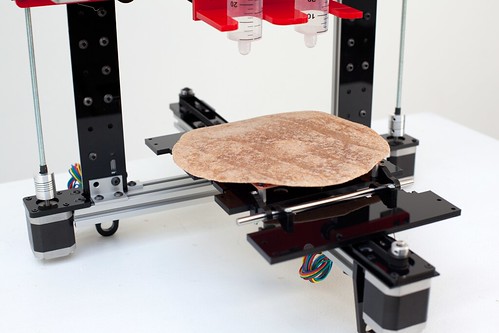
BurritoBot marks a mix between 3D Printing and Food. Looking at the mass consumed burrito and how they can make it into an automated process. They are also taking data about the global supply and demand of the ingredients and changing the recipe depending on this data. Once again an interesting way to taste data in real time. 


3. Up! 

An interactive experience where by giving a phone call to a specified number you had the chance to blow up a balloon on screen (You blew air into the mouthpiece of your phone and the balloon on the screen blew up). I am really enjoying looking at other interaction points for the phone besides the touchscreen. What I enjoyed about this project is that it really opened up the possibility of what you can do with a mobile device. Here is how ING have been using mobiles to interact with screens. 


4. RÂșad’io’’


'RÂșad’io’’ is an interactive installation that allows the user to explore the American cultural landscape by tuning into the various radio stations playing around the country.' There hasn't really been much innovation around radio stations and the dial. I thought this was a really nice presentation of this information and it looked great! 

Physical Digtial Products in Music - 6 examples

There have been a number of cool projects/products of late breaching the physical digital space in regards to making the music experience better. Here are five that caught my eye.

1. Change the tune

Allows you to change the tune by throwing paper at a poster. It is based on a motion sensor that sits within the poster and triggers the next button on Spotify. Made by the UK Agency 'Agency Republic'

2. Spotify Box

I really like this software to hardware example, they have created a boom box which reacts to what RFID tag is on it. The RFID tags are loaded up with playlists from Spotify.

3. Coachella and Facebook Check In

Using RFID tags within the access bands, punters are able to 'Check In' on Facebook to different acts through out the festival. You need to preregister your tag online to allow permission on Facebook for this to happen. This was seen a few years ago in Israel for Coca-Cola Village.

4. Firehero

This is a great DIY from the Arduino community - Guitar Hero on Flamethrower programmed through Arduino

5. Turntable Rider

This devices allows you to make music from riding your BMX. It tracks the movement of the bike through space to create data that is then translated into sound. This project was a collaboration between hip-hop and dance artist DJ BAKU, award-winning BMX rider Kotaro Tanaka, and interactive artist Toshiyuki Sugai

6. Nike Shoes

Turntable Rider is working on the same presence of Nike Song Shoes which makes music depending on how the shoes are flexed. It seems that making instruments out of objects is big in Japan.

BF Goodrich - Awesomecross

Tracking all the data that can be tapped around movement is also something that is part of the latest project from the Physcial-Digital Agency Deep Local. Although they didn't try to create music with the output, they were able to show the intensity of driving with BF Goodrich tires.

Let me know if you have any more great examples that I have missed.

The Problem With Being A Jack-Of-All-Trades

James Aviaz moved to New York from Sydney in October 2010. He's currently Marketing Manager for music startup Songtrust , having previously helped launch operations for Uber in New York. James is also working on Records Abroad - a music discovery site highlighting new music from outside the US and England.

For the better part of my adult life, I've prided myself on being pretty good a bunch of things: writing, talking to people, drinking, the Internets, tasks involving some kind of strategic thinking. For the longest time, this seemed like a great strategy. Being kinda good at a bunch of things makes me more employable / likable, so went the theory. And then New York happened.

New York is the home of the elevator pitch. People want to know who you are, what you want, and how they can help. You see, Australia is not a country that punishes those without straight answers to these questions. We prefer to start sentences with evasive words like: 'Yeah, nah...' HONESTLY, WHAT THE FUCK ARE WE TALKING ABOUT?

Being thrown into the New York job hunt quickly jolted me out of 'yeah, nah'-ville. And if anyone's been jolted recently in any way, shape or form, you'll attest to a certain unpleasantness to the experience. Think fender bender with a Mac truck.

In order to get anyone in New York's attention, you need to very quickly and powerfully surmise WHAT THE FUCK YOU WANT.

Try not to say things like, 'yeah, I'm kinda working on this thing at the moment.' WHAT THE FUCK DOES THAT MEAN TO A HUMAN BEING WITH THE ATTENTION SPAN OF A FLEA?

This is also a critical time to note that Americans ingest masses of high fructose corn syrup each day, rendering them with the patience of a hyperactive puppy. Oh look, is that another shiny thing? Yes. It always is.

The funny thing about moving to New York is the preponderance of misinformation about the city's inhabitants. One such fallacy is that: 'New Yorkers are really rude'. It was then to my surprise that 95% of all people I've met in the City have been STUPIDLY HELPFUL AND WONDERFUL. The trick is you've got to learn how to give them the best chance to help you.

The recipe for this elusive dish contains good helpings of bravado, salesmanship, and a sprinkling of razzle-dazzle. The New York Networking Moment is not a time for shrinking violets. BRING OUT THE FUCKING NUKE OF CHARM AND PIZZAZ.

New York is a city built on dreams. Entrepreneurial types are everywhere. There's not a cafe in Manhattan that at some point in the day wouldn't have a meeting about 'that big thing I'm working on that will change the world, can I have some money?' It's intoxicating. So, you best be ready to sell your dream or else get lost in the mire. Big ideas, big hopes, big shit.

Growing up in Australia systematically breeds this instinct out of you. The real winners Down Under are the guys flying below the radar pretending they'd rather drink 15 beers than work on business strategy. And if anyone dares shine above the crowd - and HEAVEN FORBID BE PROUD OF IT - they'll be cut down like a tall poppy.

And herein lies the innate difficulty of being an Aussie-come-lately in the Big Apple: everything you need to do to get people's attention, goes against the very charm of being an Australian *jolt*

Selling yourself short is bad enough, but it's even more criminal to give a confusing account of yourself. Humble should not equal bumble. Jacks-Of-All-Trades are especially bad at this. 'Yeah, I've got a bit of experience in this and that, so really I'm looking for all kinds of opportunities'. Translation to a New Yorker: "BLAH BLAH BLAH BLAH BLAH."

I've distinct memories of saying things in my early 20s like: 'don't pigeonhole yourself' and 'you don't want to get pigeonholed'. Guess what, pigeonholing is how a city bursting at the seams with Attention Deficit Disorder sufferers can compute you - and more importantly, work through their cranial Rolodex to help you in your quest. Turns out, being an expert at something is REALLY FUCKING VALUABLE.

This is probably Saturn Returns talking, but I'd love to grab my 21-year-old self and say: 'Hey mate, fucking chase your dreams and be excellent at something you love. In 10 years time, you'll have an enormous network of contacts, experiences beyond your wildest dreams, and you'll be an expert - something people will PAY YOU VERY WELL FOR.'

The most amazing people I've met have all been insanely determined to achieve something great. When you talk to them, you know exactly what they're about and what they want. To use marketing parlance *stabs self in groin*, their 'brand messaging' is always on-point and consistent. Real passion, believe it or not, seems seamless. Jacks-Of-All-Trades are like a turret gun of passion, spluttering ammunition at anything that moves. Pigeonholers are badass motherfucking snipers.

Now nearing my 30th birthday, I’m preparing to build myself a nice pigeonhole in which to get comfortable. Let's hope I go 'coo coo', rather than 'cookoo'.

AFL Memes - Image based memes go mainstream

Image based (macro) memes have long been a stalwart of Internet culture. It appears that similar to l33t speak they are about to enter mainstream culture. Last month very light internet users started posting image based memes about KONY 2012. Now the second example of this is with the FB Page AFL Memes growing to over 40,000 fans in 2 days.

It appears that brands are also catching on to the image meme train with Pure Blonde posting image based memes for the last few months. The interesting thing about macros memes is that they have a really nice organic growth component to them for the owners of the meme. Image based memes have a tendency to be shared quite a lot more than other pieces of content on Facebook. This allows brands to get a nice natural growth of fans and hopefully an end to the painful 'like this' status updates that brands have been abusing lately.

6 lessons learnt from launching a Passion Project - Twantrum


On December 6th James Aviaz, Rhys Edwards and I launched a little side project, Twantrum.com. The website used the Twitter API to search for keywords of people having outbursts at brands over Twitter. It ended up with over 10,000 page views in 14 days. It also cracked into the Top 5 Most Popular Articles of the day on The Next Web with over 500 RT. . The great thing about running little side projects is that you walk away with a number of learnings from the process. Here are my top six learnings.

1. Success was in telling the story
The major reason this idea succeeded is because of the great write up that was given on The Next Web. Twantrum.com was the kernel of the idea but it really needed someone to explain it in detail. James was lucky enough to know CBM at TNW who thought it was worth covering. I think that this is one of the biggest oversights with people launching ideas online, they don't think about locking in that big first story.

2. Double the amount of time needed
The original idea came to James in August, we thought we would be able to knock it over in 2 weeks. This project seemed simple, all we had to do was come up with the keywords, design the one page website and simply code it. It was actually a rather long process, the fact that this was a side project and we all had full time jobs, blew out the amount of time it took.

3. Line the idea with hooks
One of the things that I have noticed in my short time of getting ideas out there, is that you need to give people a number of different hooks into the idea. People love a good name. Twantrum got to the core of the idea really fast. The new old technology formula (old symptom + new technology = name) is always a winner (check Boost Mobile Textaphrenia)

The other major hook was the different levels of Twantrum, having a Mel Gibson level as the top, gave it a bit of cheek and another thing for people to talk about.

4. Talking about Twitter on Twitter is always going to be fruitful
The one thing that everyone on Twitter has in common is that they all use the technology, any story about twitter is always going to get a high propensity of RTs. This theory holds strong over other platforms too - Reddit and Redditors Wife Meme always does well.

5. International Audience
You would be surprised by people translating an article into another language how many additional views that will bring to a project. We were lucky enough to get the idea picked up by a Spanish Marketing site.

6. Ideas have a 48 hour window online
Content moves fast online and as like most ideas we had a 48 hour window where it saw a lot of eyeballs after that people moved on to the next thing. There is no real slow build with these type of projects.

11 trend predictions for 2012

Ben Phillips and I looked into the murky crystal ball and pulled out eleven amazing trends/headlines/things that you will see in 2012.

1. The 1% fight back #occupycenterlink
2011 was dominated by the #occupywallstreet movement, and the 99% protesting against the gross inequality of wealth distribution in the western world. In 2012, the 1% will strike back. Expect a similar format of protest to what we saw in 2011, with a couple of minor variations. Whilst the disgruntled masses occupied the bastions of capitalism, the idle aristocracy will occupy benefit centres, fighting against the unjust support of the less well-heeled. In the #occupycenterlink movement, bankers, lawyers and other associated gentry will erect Gucci tents and don Ralph Lauren ponchos. Through Bose megaphones they will rally, arguing for a termination of the welfare state and a restoration of true laissez-faire economic policy. Whether this movement will generate the same momentum as its poorer counterpart remains to be seen.

2. G-Stalker
In an attempt to leverage recent facial recognition patents, as well as digitally enabled voyeurism, Google will launch G-Stalker. The G-Stalker application enables a stalker to obtain every piece of information about someone that they are close enough to take a photo of. It works as such: the stalker sees an attractive woman sitting 15 yards away from him in a restaurant. He is old, recently divorced and sexually frustrated, so he pulls out his smart phone with a 10 megapixel camera and activates G-stalker. He holds the camera subtlety in the direction of the stalkee and waits for the patented facial recognition technology to do its magic. 5 seconds later, he has a name, phone number, address and a URL of every social networking site she belongs to. He leaves the restaurant, follows her on Twitter and mentally prepares himself to retweet even her most inane utterances in a feeble attempt to be noticed.

3. The demise of European fashion houses
High fashion has been criticised for many things over the years but none have managed to dent its allure to consumer hoards around the world. Times however, are changing. If the internet has taught us anything, it’s that allowing the masses to create is always a better option than reserving it for those who have spent years honing their craft. Enter Etsy. Etsy has proven that a talented, experienced fashion designer has nothing on your best friend’s sister who is in fashion school and is crocheting beanies in her free time. In what truly is a modern day peasant uprising, expect these Etsy queens and their unfortunate boyfriends to topple 1000 year old fashion houses with ill-conceived dresses, blazers and scarfs. A Louis Vuitton designer, whom asked to remain anonymous, recently told me “This is the Youtube of the fashion world. Unfortunately for us, people just want to look like depressed, malnourished hippies”. Expect high street retailers to adjust their procurement policies accordingly.

4. Social media sentiment monitoring replace the election process in France
The French election is coming up in 2012. Given the relatively poor voter turnout in previous years, I forecast that the traditional, antiquated voting process will be cancelled completely. In its place, social media monitoring firms, with their highly accurate sentiment analysis, will survey opinions of French citizens across social networks, blogs and other online forums. Citizens will be encouraged to express their opinions of candidates, and these opinions will be monitored and evaluated by the powers that be. At the conclusion of this process, the firms will deliver the results of the election and the government will take its rightful place. This anticipated development is perfectly aligned with one of the most observable behavioural trends of an election year: an explosion of ill-informed political experts using their personal social networks to push an agenda.

5. “Goldfish syndrome”
There are too many screens in our lives. Laptops, second monitors, iPhones, Blackberries, iPads, screens in retail, screens outside, TVs at home, TVs in our bedroom. The effect of this is that our concentration is being pulled from flashing screen to flashing screen more frequently than ever before, undermining our ability to actually think and function. We now no longer have the ability to concentrate on anything for more than 10 seconds at a time and given the continued explosion of multi-screen culture, I expect Goldfish syndrome to finally hit critical mass in 2012. The effects of this will be varied and profound; GDPs will further plummet as we aren’t able to concentrate on a single task for more than 10 seconds. A new range of mobile phone tariffs around 10 second conversations will be introduced, ensuring we never forget who we’re speaking to. Books will finally be killed off for good as no reader can focus on anything more than tweet length, reducing the need for paper and enabling a healthy regeneration of the Amazon. The sophistication of cars will grow significantly; this new intelligent vehicle will remind their driver every 10 seconds where they’re going and what they have to do there. Dystopian futurists will label this “the broken record society”, but this author can see a range of benefits, most notably a decline in anger and frustration because we can’t remember the origin of our misery. (side note: this paragraph took 2 weeks to write)

6. First person uses a QR code
In what will be seen as a massive coup for the QR Code community, in 2012 the first normal person will use a QR Code. Steve Stuart will be caught at a bus stop taking a photo of a QR Code for access to the BHS of The Hangover 3. QR Code fan boys will make this into an exciting case study video which will be RTed for dayzzzzzzzz and used to slam down the throats of marketers why their billboard needs a code innit.

7. Groupon to get out of debt crisis
Greece will become the first Government to turn to Groupon to help solve its debt crisis. The Government will look to sell off one of their greatest assets the Parthenon. Offering bricks that will last a lifetime over the group buying site. The bricks will be at the ridiculous reduced 90% off price for only 2 days only. This will be seen as the first step of the Greek Government to take control of their problems.

8. Head of Mobile, we were wrong not ‘The year of the mobile’
On December 31st 2012, Phillip MacPherson, Global Head of Mobile Development Foundation will come out with a statement apologising for inaccurate statements provided to the media in 2001, 2007, 2008, 2010, and 2011 which have all alluded to it being ‘The year of the Mobile’. ‘Clearly we have got it wrong the last few years, we got a little excited when the Nokia3310, WAP iPhone, iAd, all coming out and thought it was our time.’ However MacPherson still has high expectations that mobile advertising will leap frog urinal advertising as the 13th highest revenue media environment in 2013

9. Amazon launches Kindle Phone
Off the success of the Amazon Kindle, Amazon make their first play into the crowded mobile telecommunications space. ‘We really tapped into something with the Kindle, people just wanted a device that just did one thing, people just wanted to read books on it’ stated Adam Right, lead UX for Kindle Labs. 'Amazon have taken this strong insight and have applied it to a mobile device that simply just receive calls and texts. Get ready for the game changer.'

10. 'I hit my internet peak 10 years ago' - Prolific emailer
On the 10 year anniversary of Jerrod Leon registering the email address hotmale@hotmail.com, he finally admits that he may have hit his Internet peak 10 years ago. I am your classic middle aged guy reminiscing on the time he was QB for his High School Football team, only I hit it on the internet. I am on the down hill slope afterwards, I thought I might be able to replicate the Internet Greatness with getting Facebook url '/MarkZuckerbergsMum' but none of my mates laugh anymore and they are getting tired of me pulling out my business cards at bars trying to impress girls.

11. Buzzfeed, Home of LOLCats, Memes and Celebrity Gossip becomes the most influential site in the 2012 US Election
Oh shit that is actually happening.

After industry blogging

Industry blogging (Op-ed blogging) is definitely on its last legs. I think there are now three routes that I can see people taking if they still want to be having a voice in the industry.

Content Syndicators (Brainpicker, Digital Buzz Blog) this is a hard role as you have to be trawling a lot of content and on top of everything, the only big example in Australia that I have seen for this is Digital Buzz Blog.

Content Creators - Creating small projects that will get you attention. Usually these take a long time to create. Re: Digital Creatives doing Awesome Things

Become a News Source (Mumbrella, Campaign Brief) breaking news stories about the industry.

What other routes can people take?

Reviewing the success of the Occupy Wall St Communication Strategy

It is amazing to reflect on how much the Occupy Wall St movement has achieved in just 2 months. You would be hard pressed to find someone who hasn't heard of the OWS movement. I think there is a number of interesting communication tactics that they have employed which have helped them gain a lot of coverage. Here are some of the stand outs to me.

Tactics
Occupying physical space - Occupying actual parks has given people a place to congregate and learn more about the movement, it has also helped to give a visual representation of how many people there are.

Occupy replication - The easy format for replication of taking over a public space was easy to mimic across the world. Hence it helped to spread the idea globally through local activations.
99% - The '99%' as an overall idea is perfect,  it is an easy to understand concept which in nature is inclusive. It has been propelled through the tumblr of the same name.

Veterans on the front line - They have strategically put Veterans on the front line, this has made for amazing imagery as they are the first ones that the police confront.

They have also become some of the most vocal voices in this fight


Splintering the message - Similar to any campaign you need to give people new ways to talk about the message beyond the police brutality. This shows that they may be able to keep creating new ways to keep the message top of mind coming into the election year.


Capturing everything - For the last 2 months, one of the astounding things is that amount of documentation of the event. The media has really helped propel this and make it a priority for politicians.

I am looking to write a follow up piece to this, on the problems the OWS movement currently faces and how I see them moving forward.

4 Digital Creatives doing awesome things

For most Advertising Creatives creativity does not stop at 5:30PM Friday, most have some kind of creative outlet outside of work whether that be writing children's books, tshirt lines or even setting up charities.

Digitally a growing trend that I am starting to see is Digital Creatives using the internet as their canvas. The type of art that I am most interested in is when Creatives are creating cultural statements through their pieces and capturing the attention of the masses. Here are some of my favourite;

1. Jeff Greenspan (Creative Director at BBDO)

Urban Traps (Hipster Traps)
The Most Exclusive Website (Mike Lacher and Chris Baker)
LetterBombing (Chris Baker)


2. Mike Lacher - Creative Technical Manager - Google Creative Labs

Mikala Bierma Youtube Channel
Waiting for Bieber
Shady URL
Geocities-izer


3. Ji Li (Creative Director at Facebook)
The Bubble Project
Goolery
Dummer


4. Chris Baker (Writer at Google Creative Labs)

The Likeable Constitution (Jeff Greenspan)
The Call to Action Generator

As I start to learn Photoshop and Coding I am hoping to start making some of my ideas come to life. Watch this space!

Digital Strategists learn Photoshop in 8 hours

I am really trying to grow the creative side of my brain at the moment. As I discussed in my previous post on Strategy bullets, I have really been limiting the creative side for the last few years. One of the other main barriers to me being creative was I didn't have the skills to be able to execute an idea (e.g couldn't mock it up in Photoshop, couldn't code up the idea).

I was inspired by Pon Kattera, to change this the other day. He recently taught himself Photoshop via online tutorials on lynda.com. With his glowing endorsement I signed up.

I took the Photoshop CS5 Essential Training course and have taught myself the basics to Photoshop and completed my first mock ups for work on Friday. I was surprised with how good it actually was! It is cheap at a flat rate of $25 a month for all the courses you want. You have to give it a good 8 hours and it usually helps if you have someone with you who knows the basics of Photoshop.

On a side note if you haven't watched 'You suck at Photoshop' tutorials before you need to watch them!

The new data capture - Emotional DNA Data

Collecting and creating meaningful conclusions from personal data seems to be all the rage at the moment. One area that seems to have been overlooked but of interest is emotional data capturing. Emotional DNA is left on everything photos, places, people, foods. All these can elicit powerful emotions from people.

My work colleague Kendra Salvatore came up with an interesting concept of emotional geographic mapping. Basically what if we were able to visualise the emotions we tie to different places.


One of the exercises that she does is to manually map emotions from different places. I have had a stab at it for Melbourne and Sydney which was a pretty interesting task. However I think this would not need to be a manual thing, you could hook it up to Foursquare or Facebook Places and give a little emoti on what you are feeling at the time (think Nike Plus).

'Going to your happy place' could now become prompted by technology, with a mechanic that understood what places are that happy place. Fornino's and their White Truffle Oil Pizza

Putting down the Strategy Bullets

'Strategy bullets are the fastest way to kill an idea.' That guy, 2011

One of the biggest brain shifts I have had moving to BBH, is changing from a strategy mainframe to a creative led position. Strategy is a very left brain activity, coming up with creative problems is definitely a right brain activity.

A lot of Strategy revolves around looking for patterns and the inferring meanings from these patterns, whereas creative requires you to look forward and look for new patterns. This creates a lot of tension when the two parties meet.

I noticed in creative concept meetings, I was able to kill a number of thought starters and ideas as I was looking for all the holes of where it wasn't technically possible or the lack of insight of the idea.

After being made aware of this I have really started to train myself to try and find the good in an idea, virtually ever idea has at least a kernel of goodness that you can bounce off. This has also made me be more proactive in thinking about digital ideas outside of work too, so hopefully like Zac Martin I can start moving fast and breaking things.

Super Hero Clubhouse chat solving a number of fundamental problems to online chat

Super Hero Clubhouse is a new site/thing from the people from Texts From Last Night/Bnter it is a massive step forward in the online communication/relationship space. Anyone who has had to study online communications will most likely be surprised at how many fundamentals online problems they have solved with this product.

Please go have a look around and then come back. Here is the massive problems that I see that they are resolving.

Problem - Lack of conversation starters/passion points
Most online communication are usually formed around a passion point - (Forums - IntheMix - Dance Music, 4Chan - Anime, BigFooty - AFL). With ChatRoulette where they struggled was having a passion point (which wasn't wangs). SHC starts in a role play scenario - you can talk about superheroes but they compliment this with 'Ice Breakers' which are conversation starters which you can drop into the chat.

Problem - Creeper Stalker Pedo Stigma
Online chat has always struggled with the Creeper Stalker Pedo Stigma, SHC starts conversation in a state that is the furtherest place away from creeper single stalker male territory, role playing superheroes. We aren't going to get to A/S/L questions of the bat.

Problem - Sign Up processes suck
Signing up is slick, Facebook Connect - remembers you for the long term. Then finishing the sign up is a bit of a game in creating your own character, which is a nice easy process.

Problem- Actually connecting with people after the experience
You can reveal your mask at the end of it, such a nice simple fit with the whole superhero theme

They have a created a number of nice solutions/mechanics which I will be taking and using in future projects.

Q: What's after Social Media? A: Social Data Curating

You know when three of the biggest Digital agencies in America start putting out projects using the same technique that something is about to change. CP+B, R/GA and Zeus Jones have all created Social Data Curated projects for brands in the last 3 months and it feels like it might be a growing trend.

We have come to a point where we have so much data thanks to Social Media and there is a real opportunity to make this data meaningful. Enter Social Data Curating - the ability to take these numbers of present it back as a by product that adds value to consumers.

Social was always a difficult one for Digital Agencies to get their heads around, they needed to get new resource in, Community Managers etc, the metrics for success were quite different. However the current trend of Social Data Curated Projects in which Agencies are now creating products/applications/websites lets coders and developers get back front and centre and involved in Social. The following are three projects that are going down this road.

CP+B and Jello

Jello Pudding Face aggregates the number of :) and :( tweets and then in turn effects their Jello Pudding Face meter, which is also a billboard. When the global voice goes :( they start giving away pudding to the people who have tweeted :( to try and make them happy again. Great tie into sampling, CP+B were also great at doing this with Kraft Mac + Cheese which gave away the product when two people tweet Mac and Cheese at the same time.

R/GA and Nike Basketball

Nike Basketball have arranged their athletes in terms of the how many tweet per hour that player gets, so that the data visualisation captures who are the most popular players of the moment.

Zeus Jones and Cheerios

Cheerios have taken the data around what people were searching for on the internet around Cheerios and made their website to answer those questions

Design for Entrepreneurs and Hackers

I did a great course 'Design for Entrepreneurs and Hackers' at General Assembly when I first arrived in NYC. The course was run by Jack Cheng and David Cole from Disrupto and I have finally got around to doing a write up on it.

They have got a solid framework on what makes good design. The basis of their theory is that good design is making and breaking patterns to achieve desired outcomes. A large portion of the course was talking about patterns. Patterns are recurring solutions that solve common design problems. They are shortcuts that people understand, similar to schemas. They had a number of great resources on patterns for mobile and web;

Mobile
Pttrns
Mobile UI Patterns

Web
Pattern Tap
Welie (User need patterns)
Yahoo's Patterns

Here is a great site on Dark Patterns, they are patterns that deceive the user, if you have ever had that feeling that a design is being tricky, then there is probably a case study on this site of where it has hurt a company online.

When designing anything for online they suggested there were three layers that designers needed to think about - Product Strategy, Product User Interface and Visual Design, within these you want one of these objects to be remarkable and then the others to be patterns that people are familiar with.

On a side not, on a scale of 1 to mind blowing how good is the K-Swiss/Kenny Powers entertainment????

Digital Strategy Training Guide - Using Social for Insights Mining

This is the second chapter of my MacGyver Digital Strategy Handbook

DISCOURSE ANALYSIS
Introduction
One of the oldest forms of Marketing Research is Discourse Analysis, the study of the written word. With the advent of Social Media it has given marketers, the opportunity to capture real time conversations. Understanding how people will talk about your brand/product/category can be very insightful and help to uncover new territories for the brand.

Tools to be used
Keywords Discovery

List all the names for the product and the category, using Google Search Insights (Similar Search) you will also uncover other words that people use to search for you product. Create a list of these words.

Social Media Mining
Once you have worked out your keywords it is now time to mine Social Media sites to find out what people are saying around these topics. The important thing here is to look out for common themes, start transferring all the data to an excel spreadsheet, using common theme tags to highlight the theme.

There are a number of great tools that you can use to do this.

OpenFacebook - Allows you to see what people have been writing in their Facebook Status Updates, it is estimated that about 3% of the FB population have open accounts, this still gives a good idea of how people are speaking about the product.

Example – Pens

Twiter Search - Check the search terms in twitter, the great thing about Twitter is that it shows the most tweeted tweets using those key terms. This will help uncover the common themes.

Example – Pens

Facebook Search - One of the great things about Facebook is that anyone can set up a Page/Group, what has happened is that a number of people have set up what is called 'Statement Pages' which are small everyday truths. Understanding what people agree on around a topic can be very insightful. Use the search bar and then narrow the search by looking at ‘Groups and Pages’ for those keywords.

Example – Pens

Disrupt Something And Do It Now - Guest Post from James Aviaz

James Aviaz is a Community Manager at Uber NYC

The new darlings of the tech world, and rightly so, are so-called 'disruptive' companies. Heck, New York just played host to a 3-day conference called Techcrunch Disrupt.

So, what makes a disruptive company? Essentially, these disruptors are taking old, broken industries and using innovative tech to fix their problems. Along the way, most of these companies come up against regulatory issues, requiring them to show serious cojones and nimble thinking.

These companies are also revered for their revenue models - they take real money for real services. Something most startups only dream of when asked: 'So, how are you going to monetise this thing?'

Here's a selection of disruptive companies to check out:

1. Square

Founded by Jack Dorsey (Twitter), Square turns any iPhone or iPad into a mobile credit card machine. With a card reader attachment plugged into your audio jack, you can literally take card payments anywhere / any time. Square takes 2.75% of each transaction. Yep, it's fucking genius.

2. Uber

Ever tried getting a yellow taxi in San Francisco? It's a nightmare. Two entrepreneurs Garrett Camp (StumbleUpon) and Travis Kalanick (Red Swoosh) took the challenge on-board and turned a dormant, disparate network of luxury cars into a fully-functioning yellow taxi alternative. Now in NYC, Uber has Seattle, DC, Boston and Chicago next in its sights.

(Disclosure: I'm the Community Manager for Uber in NYC).

3. Airbnb

Starting as a marketplace for finding air mattresses to crash on people's floor, Airbnb founded by Brian Chesky has in the last two years become a genuine hotel alternative. Apartment owners list their cribs online for short-term rentals, and then savvy travellers snap up the awesome rooms. Just raised $100m with a valuation of $1bn. NBD.

4. Skillshare

Americans pay a shitload to go to college with diminishing returns, so Mike Karnjanaprakorn decided to 'start an education revolution'. His contention is that college success does not equal long-term job success, so he's building a learning marketplace where students take take highly-targeted classes at competitive prices.

Now ask yourself: What makes you facepalm each day? What industries are broken? What can you fix?

At a time when the tech world is on the verge an IPO bender, disruptive companies are poised to make a lot of noise. Disrupt something and do it now.